
Cryogenic Heat Exchangers
Ambient-air cryogenic vaporizers and heat exchangers
FWM ambient air vaporizers are cryogenic-to-ambient heat exchangers. Extruded finned aluminum tube pulls heat from the surrounding air to vaporize liquid nitrogen, oxygen, argon, CO2, and LNG, with no electricity or fuel required for standard operation. Designed and built in Hudson, New Hampshire since 1975.
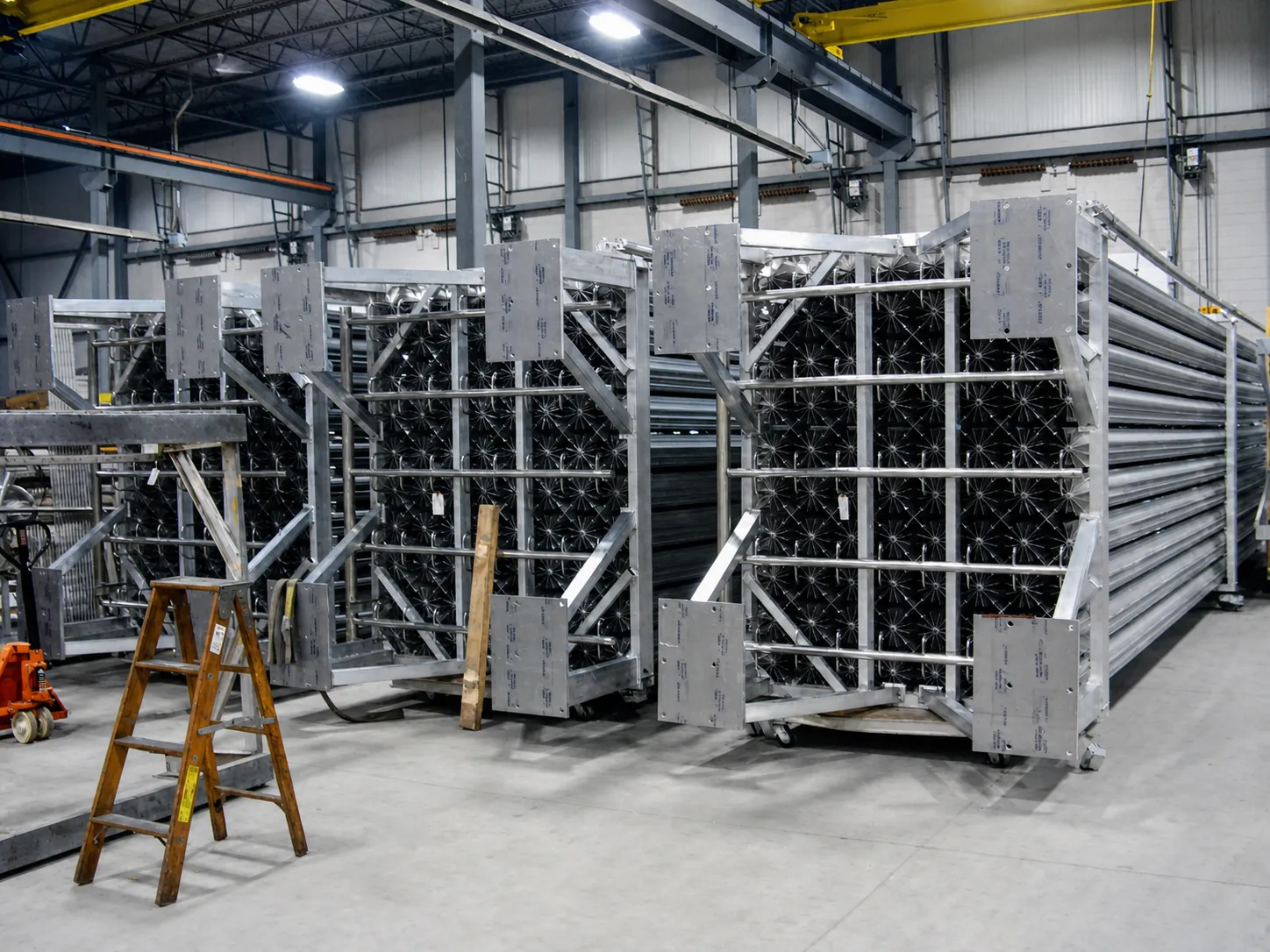
How an ambient air heat exchanger works
A cryogenic liquid is stored far below its boiling point. To deliver usable gas, the liquid has to absorb heat. In an ambient air unit, that heat comes from the surrounding air and moves through the extruded finned aluminum tube into the cryogen, which vaporizes at the rated delivery pressure.
Ambient air heat source
Air warms the fins; no electricity or fuel for standard operation.
Extruded finned aluminum
High-surface-area aluminum tube transfers heat into the cryogenic liquid.
Cryogen boils to gas
The liquid absorbs heat and vaporizes at the rated delivery pressure.
Made in Hudson, NH
Designed and built by FWM in New Hampshire since 1975.
Standard heat exchanger specifications
| Specification | DVAP Series | AV Series |
|---|---|---|
| Construction | Extruded finned aluminum tube | Extruded finned aluminum tube |
| Heat source | Ambient air (no power) | Ambient air (no power) |
| Sustained flow | 640 – 3,600 SCFH | ≈ 2,000 – 83,000 SCFH |
| MAWP | 600 PSIG | Application-specific |
| Gas service | LN2, LOX, Ar, CO2, LNG | LN2, LOX, Ar, CO2, LNG |
| Best for | Dewar & liquid-cylinder withdrawal | Bulk tanks & continuous regasification |
Flow and pressure figures are rated values; actual performance varies with gas service, ambient conditions, and duty cycle. Send your conditions for a sized recommendation.
Standard units
Two standard product lines cover most cryogenic-to-ambient heat exchange needs.
Custom, OEM & specialty
Custom & engineered
Modified footprint, flow, pressure, and connections to spec.
Learn moreOEM & private-label
Heat exchangers built for other equipment manufacturers.
Learn moreHigh-pressure stainless
Stainless configurations for elevated-pressure service.
Learn moreReplacement & cross-reference
Match flow, pressure, and footprint to your existing unit.
Learn moreFrequently asked questions
What is a cryogenic heat exchanger?
A cryogenic heat exchanger transfers heat into a cryogenic liquid so it boils back into gas. FWM ambient air vaporizers are cryogenic-to-ambient heat exchangers: they use extruded finned aluminum tube to draw heat from the surrounding air and vaporize liquid nitrogen, oxygen, argon, CO2, or LNG, with no electricity or fuel required for standard operation.
Are FWM ambient air vaporizers the same as aluminum heat exchangers?
Yes. An ambient air vaporizer is a finned aluminum heat exchanger. Ambient air is the heat source and the extruded aluminum fins are the heat-transfer surface. FWM has built these units in Hudson, New Hampshire since 1975.
What gases do FWM heat exchangers handle?
Liquid nitrogen (LN2), liquid oxygen (LOX), liquid argon, CO2, and LNG. Units for oxygen service are cleaned and tagged for oxygen use.
What flow and pressure ranges are available?
The DVAP Series delivers sustained flow from 640 to 3,600 SCFH with a 600 PSIG MAWP, sized for Dewar and liquid-cylinder service. The AV Series covers large-capacity and continuous-duty service from roughly 2,000 to 83,000 SCFH. High-pressure stainless configurations are available for elevated-pressure applications.
Can you build a custom or private-label heat exchanger?
Yes. FWM engineers custom units to a required footprint, flow, pressure, and connection set, and manufactures OEM and private-label heat exchangers for other equipment builders.
Can FWM replace or cross-reference an existing unit?
Yes. FWM builds replacement ambient air vaporizers and cross-references units from other manufacturers so you can match flow, pressure, and footprint to what you already run.
Ready to Start
Need a cryogenic heat exchanger sized for your service?
Send your gas service, flow, and pressure conditions. Our engineering team will recommend the right unit and respond within 1 to 2 business days.